
When Ruby Rose Suddenly Lost the Ability to Walk And How Advanced Neurology Care Helped Her Recover
A frightening neurologic emergency. A rare spinal condition. And the specialty care that changed her outcome.

Ruby Rose Couldn’t Stand. And Her Family Knew It Was an Emergency.
Ruby Rose, a sweet 4.5-year-old Toy Poodle, went from a normal day to a frightening emergency in moments. She suddenly lost strength in all four legs and could not stand or walk. Even though she didn’t cry or show obvious pain, her family knew something wasn’t right and sought help immediately.
A local emergency hospital referred Ruby to Pinnacle Veterinary Specialists for advanced neurologic care. When she arrived, Ruby remained quiet but unable to walk, with weakness affecting all four limbs. Our team admitted her right away and began stabilizing her while working to understand what was happening.
We placed an IV catheter, started bloodwork and IV fluids, and closely monitored her vital signs. Pain management medications kept Ruby comfortable as we moved quickly to the next steps of her care.
The following day, Pinnacle’s Neurology Service performed a complete neurologic examination. The findings pointed to the upper cervical spinal cord, leading to advanced imaging. An MRI confirmed an atlantoaxial subluxation with a spinal cord contusion, and a CT scan allowed our team to plan surgery with precision.
Given the seriousness of her condition, surgical stabilization offered Ruby the best chance at recovery. She underwent an atlantoaxial stabilization procedure the next day. The surgery went smoothly, and postoperative imaging confirmed everything was in place.
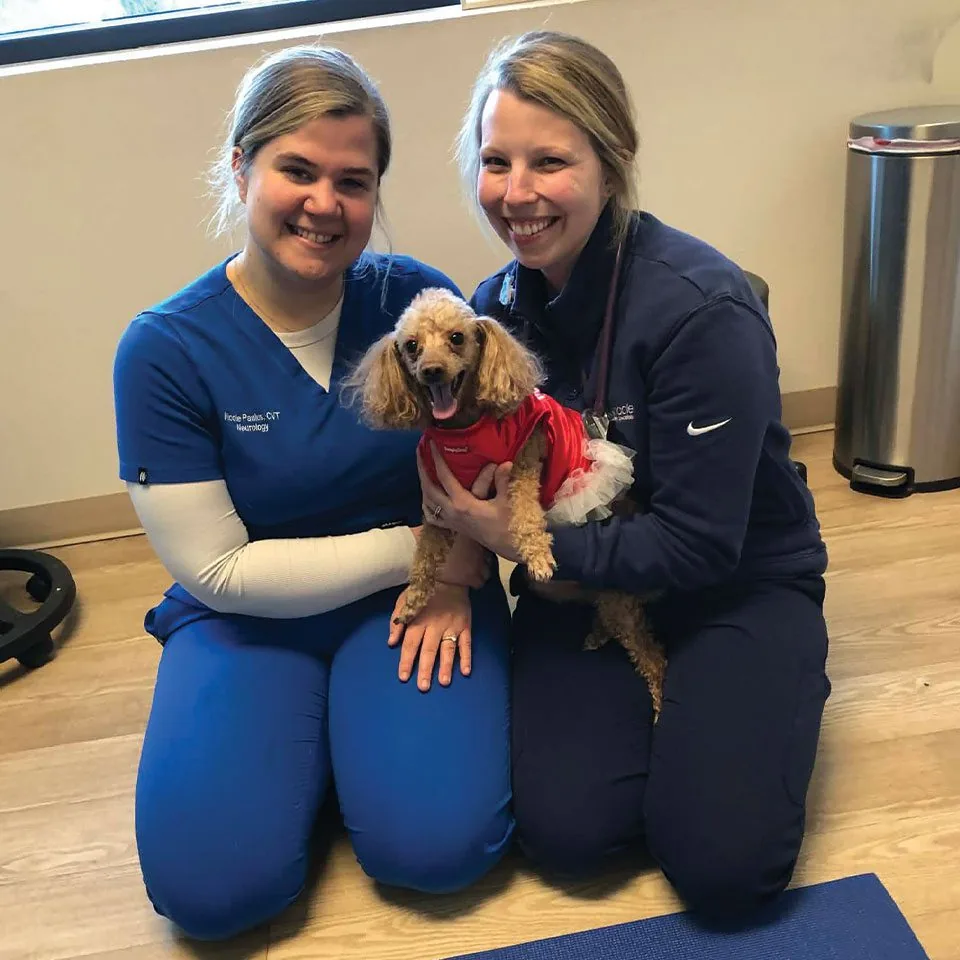
Recovery took patience and time. Ruby rested at home under strict activity restrictions, and her progress steadily improved. At her one-month recheck, she was walking on her own with only mild weakness. Six months later, Ruby was doing very well at home, continuing to regain strength and enjoy life with her family.
What began as a terrifying moment became a hopeful outcome. Thanks to her family’s quick action and the support of Pinnacle’s specialty team, Ruby Rose was able to move forward, stronger and brighter than before.
Have questions about neurologic emergencies or spinal conditions? Call us anytime at (610) 477-8797.
Clinical Case Details
Case File: Atlantoaxial Subluxation with Spinal Cord Contusion – “Ruby Rose”
Patient: “Ruby Rose” – 4.5-year-old Toy Poodle
Presentation: Acute onset of non-ambulatory tetraparesis. Quiet demeanor, no vocalization or overt pain observed. Previously healthy.
Clinical Findings
- Neurolocalization: C1–C5 myelopathy
- Gait: Non-ambulatory tetraparetic
- Proprioception: Absent in all four limbs
- Reflexes: Normal
- Cervical palpation: No obvious pain; cervical flexion avoided
- MRI: Atlantoaxial subluxation with spinal cord contusion, no dens visualized on C2
- CT: Performed for surgical planning and implant measurement
Treatment Protocol
- Emergency stabilization with IV fluids and pain management
- Neurologic evaluation by Neurology Service
- Advanced imaging (MRI and CT)
- Surgical atlantoaxial stabilization
- Postoperative radiographs confirming implant placement
- Strict activity restriction for eight weeks
Outcome
- Surgery completed without complications
- One-month post-op: Ambulatory with mild weakness in all four limbs
- Six-month post-op: Doing very well at home with continued improvement
Clinical Takeaway: Atlantoaxial subluxation is a serious and potentially life-threatening condition, especially in small-breed dogs. Early neurologic evaluation, advanced imaging, and timely surgical intervention can significantly improve outcomes. Ruby Rose’s case highlights how specialized care and careful recovery planning can restore mobility and quality of life.
Want to refer a neurology case?
Refer online or call us at (610) 477-8797.
Ruby Rose’s Recovery Journey
Day 1
Acute onset tetraparesis, ER referral, stabilization at Pinnacle
Day 2
Neurologic exam, MRI and CT imaging, diagnosis confirmed
Day 3
Atlantoaxial stabilization surgery performed successfully
Weeks 1–8
Strict rest and monitored recovery at home
Month 1
Ambulatory with mild weakness
Month 6
Doing great at home with continued improvement
Why Choose Pinnacle?
At Pinnacle Veterinary Specialists, we provide advanced specialty care when pets need it most. From emergency stabilization to complex neurologic surgery and ongoing recovery support, our team is here to guide families through the most overwhelming moments with skill, clarity, and compassion.
When every movement matters, we focus on protecting what matters most.
Advanced Care. 24/7 Monitoring. Emergency-Ready.
Have a Critical Case? We’re Always Ready.